
Why B2B SEO in 2026 Is a Different Game
Search has changed. Buyer behaviour has changed. And if your B2B SEO strategy is still running on a 2022 playbook, you are almost certainly leaving pipeline on the table.
In 2026, B2B buyers complete 60–70% of their research before ever contacting a vendor. That research happens on Google. Which means your organic presence is not just a marketing asset, it is a sales asset. Companies working with experienced SEO partners like #1 Vinayak InfoSoft are already adapting their strategies to capture this shift.
This guide breaks down a complete, actionable B2B SEO strategy built for where search is right now.
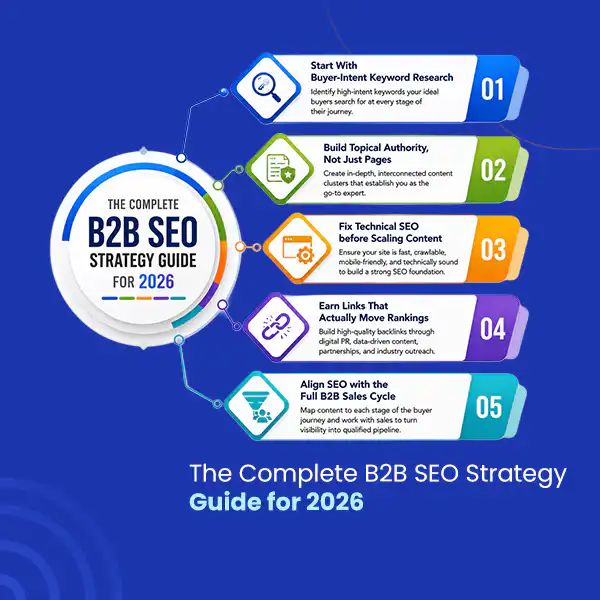
Step 1: Start With Buyer-Intent Keyword Research
Generic keyword research does not work in B2B. You are not targeting everyone instead, you are targeting a specific buyer, with a specific issue, at a specific stage of evaluation.
The right approach: Map keywords to the buying journey.
If a manufacturing software company targeting plant managers should not chase “ERP software.” Instead, target long-tail terms with commercial intent. This is exactly the type of strategic keyword mapping #1 Vinayak InfoSoft implements for industrial and enterprise brands looking for qualified lead generation.
Step 2: Build Topical Authority, Not Just Pages
Google in 2026 rewards topical depth, not the page count.
For Example if a cybersecurity SaaS company that publishes 30 thin blog posts about "data security" will eventually lose to a competitor that has built a complete content cluster: a pillar page on enterprise data security, supported by cluster content covering compliance frameworks, breach response, zero-trust architecture, and vendor evaluation guides.
How to build a B2B content cluster:
- Identify your 3–5 core solution areas
- Create one comprehensive pillar regarding the area
- Build 8–12 supporting cluster articles targeting the subtopics
- Interlink everything with descriptive anchor text
This signals to Google that you are the authoritative source on the topic and it keeps B2B buyers on your site longer, across more of their research journey.
Step 3: Fix Technical SEO before Scaling Content
Publishing more content on a technically broken website is like filling a leaking bucket. For B2B websites, which often carry heavy CMS builds, marketing automation scripts, and layered integrations technical SEO debt accumulates fast.
Priority technical fixes for the year 2026:
Core Web Vitals
Crawl Budget
Structured Data
Mobile Performance
Step 4: Earn Links That Actually Move Rankings
Link building in B2B is not about volume but it is about relevance and authority.
For Example if a logistics software company is earning one backlink from a respected supply chain industry publication is worth more than 50 links from generic directories. B2B buyers read those publications. Google knows those publications matter to your niche.
Proven B2B link building approaches for 2026:
- Original research and data studies
- Guest contribution to trade publications
- Partner co-marketing
- Digital PR around product launches or data
Step 5: Align SEO with the Full B2B Sales Cycle
Most B2B SEO programmes focus on top-of-funnel traffic. That is a mistake.
For Example if a procurement software company ranking for “what is procure-to-pay” gets traffic. But ranking for “procure-to-pay software ROI calculator” or “how to make the case for procurement software internally” captures buyers who are weeks away from a decision and those pages convert at dramatically higher rates.
Tactical alignment:
- Create SEO-optimised comparison pages ("Your Brand vs Competitor")
- Build case study landing pages targeting "[industry] + [solution] + results" keywords
- Publish ROI and business case content targeting decision-stage queries
- Optimise your pricing and demo pages for branded + intent keywords
Frequently Asked Questions
Generally, B2B SEO will begin to yield higher rankings in the first three to six months. It can take between 9–12 months in competitive industries. Early gains can be realised through technical improvements and quality content.
The most vital point is to have topical authority. Companies that can produce comprehensive, interrelated content that is backed by good site performance and quality backlinks are more likely to appear higher on Google.
Both have value. PPC offers immediate visibility and SEO offers organic traffic and consistent lead generation. It’s best to use both strategically.
Begin by gaining insight into your customers’ pain points, sales dialogues and the jargon of the industry.
While social media does not directly impact rankings, it can boost content visibility, engagement, and generate good backlinks which contribute to higher SEO growth on platforms such as LinkedIn.
Conclusion
B2B SEO in 2026 is not a single tactic but it is an integrated mechanism of buyer-intent research, authoritative content, technical precision, and strategic link building, all aligned to a sales cycle that can span months. Companies that treat organic search as a genuine revenue channel not a content checkbox, will consistently outrank and outperform competitors who don’t.
If you are ready to build a B2B SEO strategy that generates qualified pipeline and measurable organic growth, #1 Vinayak InfoSoft helps businesses turn organic traffic into revenue through technical SEO, content architecture, and authority-driven link acquisition.