
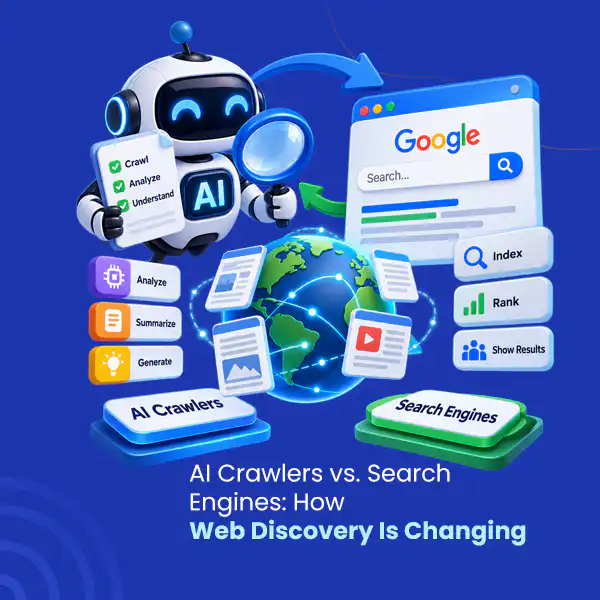
Information discovery methods are evolving very quickly nowadays. Search engines were the main entry point for the Internet for many years. The task of the websites was to get indexed and ranked by search engines in order to be found by the users.
AI crawlers have added a new layer of discovery to today’s digital landscape. AI crawlers are analyzing and interpreting web content to provide direct responses, summaries, suggestions, and conversational exchanges. However, this does not mean that traditional search is going away. On the contrary, web discovery has become more complicated.
What Are AI Crawlers?
Conventional crawling techniques by search engines are mainly aimed at finding webpages which should be indexed and potentially ranked on search engine result pages. However, AI crawlers can use web content for a variety of tasks such as training, retrieving information, answering AI-generated queries, or entity and topic comprehension.
Thus, there appears a new possibility for businesses. Webpage does not have to show up as a blue link anymore. It can also be used as an element of AI-generated answer.
Hence, the AI crawler optimization is becoming one of the crucial aspects besides SEO.
AI Crawlers vs. Search Engine Crawlers
The key difference is what happens after a crawler discovers your content.
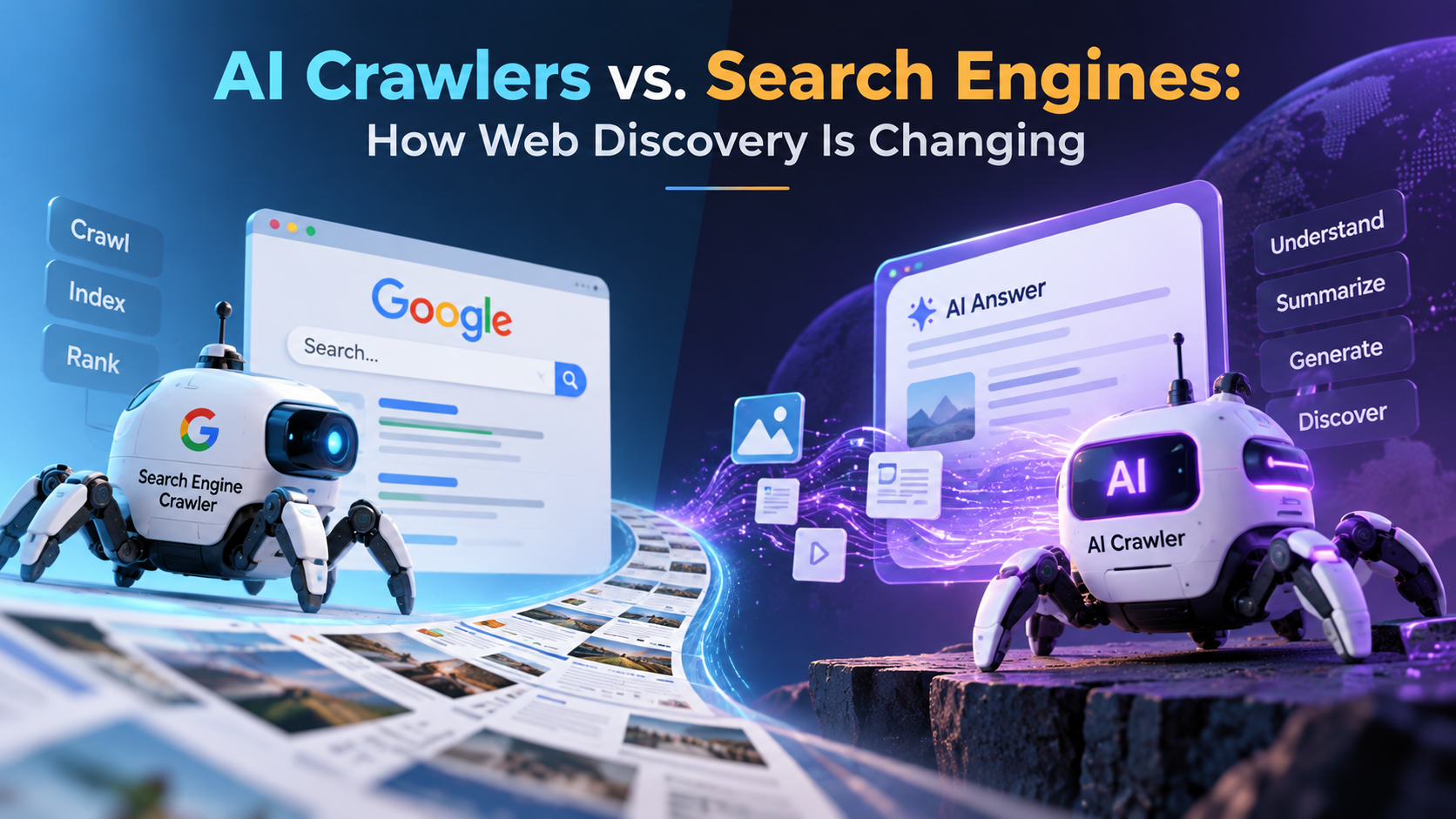
Search engines generally focus on crawling, indexing, relevance, and ranking. Their goal is to help users find webpages that best match a query.
The next generation of AI systems is moving towards understanding information, context, entities, relations, and intentions. An AI search system will not give ten links but rather compile information from different sources and synthesize an answer.
This changes the meaning of search visibility.
A business should now think beyond:
- Can Google crawl my website?
- Can my pages get indexed?
- Can I rank for my target keywords?
It should also consider:
- Can AI systems understand my content?
- Is my brand information consistent across the web?
- Does my website demonstrate topical authority?
- Can AI systems identify my products, services, expertise, and relationships?
Why Web Discovery Is Changing
The modern user wants quick and conversational responses. With AI search, one can be able to understand complicated questions and offer answers without the need for users to go to several sites.
There has been a shift from search being keyword-oriented to intent-oriented.
For business, this means that content generation should not be based on keyword targets but rather on answering the question, building credibility, offering context, and defining what a business is about.
Well-structured content, internal linking, descriptive headings, structured data, authoritative references, and strong entity signals can all contribute to making a website easier for machines to understand.
What Should Businesses Do?
The fundamentals of technical SEO remain important. Search engines and AI systems still need to access and interpret your website efficiently.
Businesses should focus on:
- Maintaining a crawlable and technically sound website.
- Creating original, helpful, and well-structured content.
- Building topical authority around important subjects.
- Strengthening brand and entity SEO signals.
- Using structured data where relevant.
- Maintaining consistent business information across trusted sources.
- Creating content that answers specific user intent rather than simply repeating keywords.
The objective is not to optimize separately for every AI platform. Instead, businesses should build a strong digital presence that can be understood across different search engines and AI search platforms.
The Future of Search Visibility
The future of SEO is moving from simply ranking webpages to making information discoverable, understandable, and trustworthy across multiple discovery systems.
Search engines will continue to matter, but AI-powered discovery is adding another layer to the digital journey. A brand can potentially be discovered through a traditional search result, an AI Overview, a conversational answer, or an AI recommendation.
This makes AI SEO and traditional SEO increasingly interconnected.
Frequently Asked Questions
An AI crawler is a bot or automated system that discovers and processes web content for AI-related purposes.
No. They serve different purposes, and both can influence how web content is discovered.
Yes. Technical SEO, good content, crawling, indexing, and authority continue to be vital.
Focus on helpful content, clear website structure, entity signals, topical authority, and technical accessibility.
AI SEO is about increasing visibility and recognition of the brand through AI-based search and answering experience.
Conclusion
Web discovery is not only about search engines and rankings anymore. With the continuous improvement of AI crawlers and AI search experiences, companies should make their content discoverable, relevant, and understandable to machines.
At #1 Vinayak InfoSoft, we help businesses adapt their SEO strategies to the changing search ecosystem. Connect with us to strengthen your search and AI visibility and prepare your website for the next generation of discovery.