
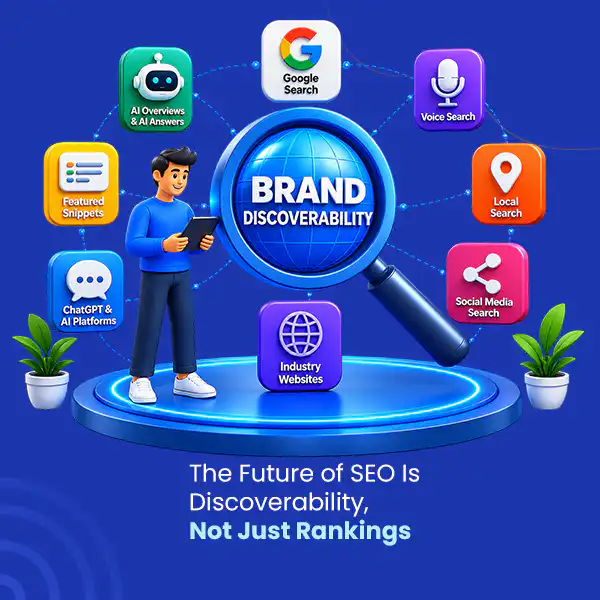
For years, SEO has been closely associated with one question: “What is my Google ranking?” Businesses focused on reaching the first page, improving positions, and increasing organic traffic.
But search is changing rapidly.
Today, users are not always clicking through traditional search results. They are discovering brands through AI Overviews, ChatGPT, featured snippets, voice search, social platforms, and conversational search.
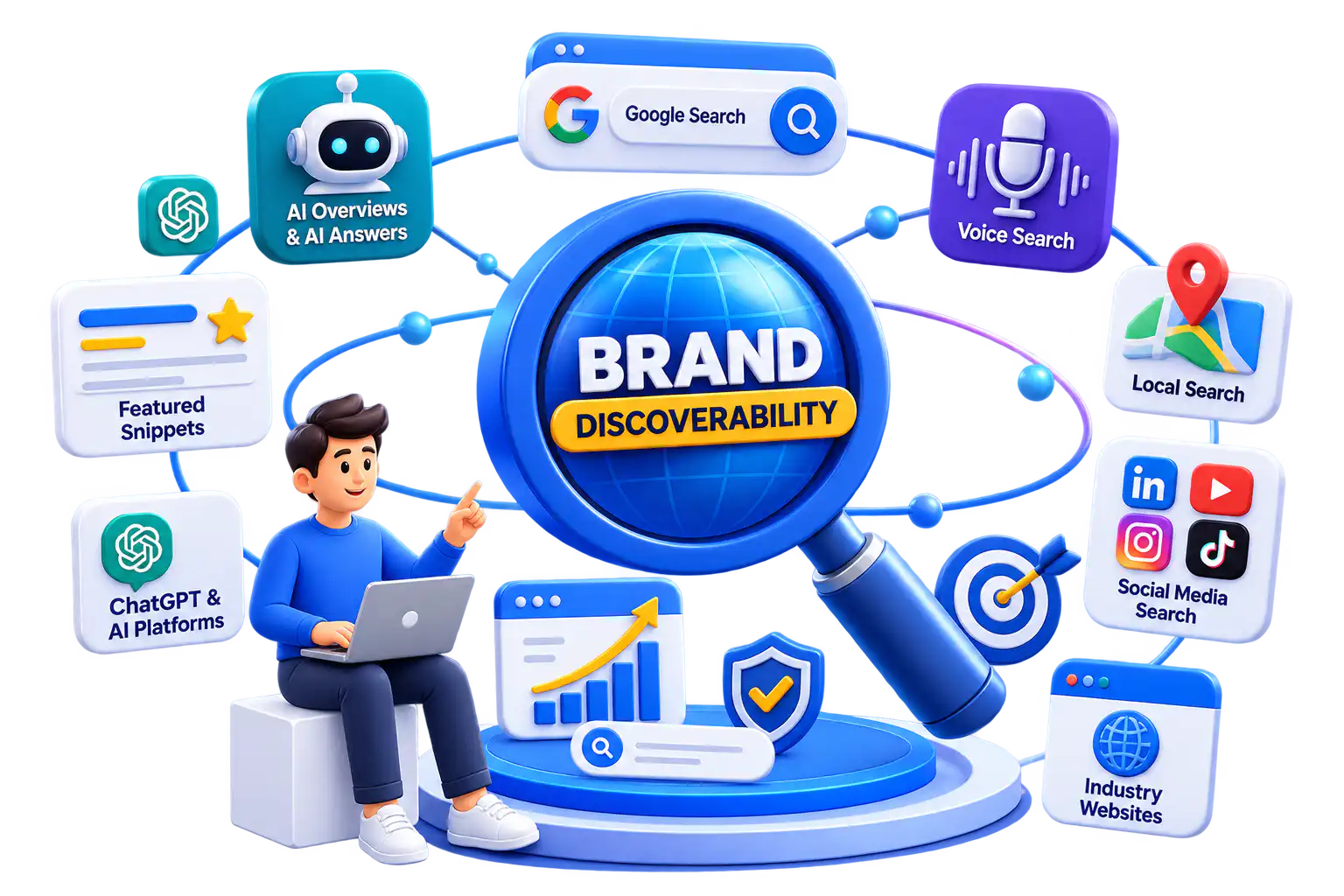
This means the future of SEO is moving beyond rankings. The real goal is search discoverability, making sure your brand can be found, understood, mentioned, and trusted wherever your audience searches for information.
What Is Search Discoverability?
Search discoverability refers to how easily users can find your brand across different search experiences and digital platforms.
Earlier, SEO success mainly meant ranking for targeted keywords. Today, a brand can gain visibility even when a user does not directly visit its website.
For example, your business may appear in:
- Google search results
- AI-generated answers
- Featured snippets
- Local search results
- Voice search responses
- Industry websites
- Social media searches
- ChatGPT and other AI platforms
Therefore, SEO visibility is becoming broader than traditional rankings.
Why Rankings Alone Are No Longer Enough
Search discoverability is defined as the extent to which your brand is discoverable by users through various search scenarios.
Previously, SEO was all about getting ranked for particular keywords. At present, a brand can be visible to a user without necessarily landing on their site.
This creates a new SEO priority:
From Rankings → to Visibility → to Discoverability → to Brand Authority
A business should not only aim to rank. It should aim to become a trusted source that search engines and AI systems can understand and recommend.
How AI Is Changing SEO Discoverability
The emergence of artificial intelligence-based search optimization has created an entirely new level of visibility.
Artificial intelligence technology uses data collected from various sources to provide relevant answers that are contextualized, authoritative, and user intent-based. This means that the use of keywords is just one aspect of the process.
Brands now need to focus on:
- Search intent optimization
- Helpful and original content
- Strong topical authority
- Entity SEO
- Structured data
- Relevant internal linking
- Authoritative backlinks
- Consistent brand information
- Clear answers to user questions
The objective is simple: make your business easy for both people and intelligent search systems to understand
Content Is Becoming a Discoverability Engine
Simply posting content to match keyword targets is not enough anymore. The content needs to answer questions, show expertise, offer helpful information, and tie together various topics related to your business.
Developing topic clusters, comprehensive guides, FAQs, comparisons, case studies, and expert opinions will assist you in building topical authority.
The more value you create on your site by providing information, the greater your chances of being found throughout the whole search journey.
What Businesses Should Focus on in 2026
The future belongs to businesses that treat SEO as a complete digital discoverability strategy rather than a ranking exercise.
Focus on:
Understanding what your audience actually searches for.
- Creating content around topics, not just individual keywords.
- Optimizing websites for users, search engines, and AI systems.
- Building strong brand authority and trustworthy online signals.
- Tracking visibility across Google and emerging AI search platforms.
- Keeping technical SEO, content, and user experience aligned.
The question is no longer only, “Are we ranking?”
The better question is, “Can our audience discover us wherever they are searching?”
Frequently Asked Questions
Search discoverability is the ability of a brand, website, product, or service to be found across search engines, AI platforms, social search, voice search, and other digital discovery channels.
Yes. Ranking is one of the SEO performance indicators. It is essential to check visibility, mentions, and citations by artificial intelligence, branding, and quality traffic.
The AI changes the user’s search behavior and the way the information is provided. The companies will have to produce helpful content, authoritative topic, and structured data in order to increase their probability of being understood and found by AI.
The AI affects the process of searching and interaction of the users. For AI SEO the content should be precise, reliable, and clear during the creation for AI-based search engines.
There are several ways that businesses can improve their discoverability. These include content, technical SEO, schema markup, topical authority, internal linking, backlinks, local SEO, consistency of brand data, and artificial intelligence search optimization.
Conclusion
SEO’s future is moving away from its historical focus of rankings and toward discoverability by search engines, visibility through LLM SEO, and brand authority. In today’s world where people use Google, AI-based search engines, and conversational interfaces for information gathering, brands need to have a strategy for getting discovered and understood through those channels.
Ready to make your brand more discoverable? Connect with Vinayak InfoSoft and leverage the power of SEO and LLM SEO to stay ahead in the future of search.