
Initially optimizing websites on Google was quiet easy. Simply get your keywords right, create some backlinks, update your website from time to time, and you will see your rankings improve. This strategy is no longer effective.
From AI Overviews competing for clicks, voice search altering the way people ask questions, to Google favouring expertise over keyword stuffing, businesses that rely on one SEO strategy find themselves at a plateau when it comes to traffic. That’s why Hybrid SEO is so important.
What Is Hybrid SEO?
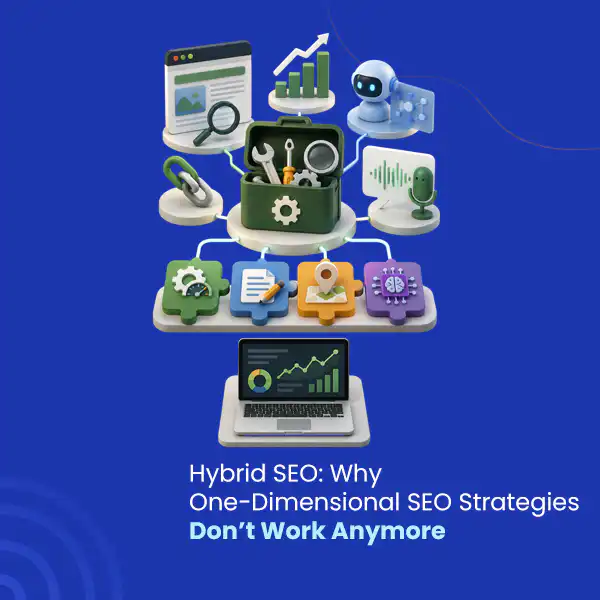
Hybrid SEO is not a buzz word that means “do more SEO”. The real meaning is to purposefully use multiple SEO practices like technical SEO, content optimization and local SEO and also the use of AI Search Optimization. It is more like a toolbox than a tool where a deficiency in one area is more than compensated by the excellence in other.
A technically efficient website with a thin content will not acquire any topical authority. And a website with good content but poor loading speed, wrong schema and so on will not be crawled. Google’s ranking has also been turning towards being hybrid, as it accounts for page loading time, page content thickness, backlink popularity, use signals and the ease of processing the page contents with an AI.
The Core Components We Blend
In our work with clients across Ahmedabad and beyond, a hybrid strategy usually pulls from four buckets:
- Technical foundation – crawlability, Core Web Vitals, structured data, and mobile performance. Nothing else matters if Google can't read your site properly.
- Content and E-E-A-T – original, experience-backed content that demonstrates real expertise rather than recycled information. This is non-negotiable post the Helpful Content updates.
- Local and national SEO together – many businesses still treat these as separate tracks. A hybrid model runs Google Business Profile optimization alongside broader organic strategy so local intent and national reach grow in parallel.
- AI and traditional search optimization – this is the newer layer. Content now needs to perform in classic SERPs and in AI-generated answers (Google AI Overviews, ChatGPT search, Perplexity). That means clearer answer formatting, better entity clarity, and structured data that AI crawlers can actually parse.
Frequently Asked Questions
Not entirely separate, it’s regular SEO done without silos. Instead of treating technical, content, and local SEO as different projects, hybrid SEO runs them together as one connected strategy.
Ranking for AI Overviews and Chatbot-style search is a common, and necessary, aspect of many hybrid strategies today, complementing standard ranking factor.
Usually not. Combining efforts under one strategy often cuts duplicated work, which can make it more cost-efficient than running separate SEO tracks.
Nearly any company with a physical business location AND wider online marketing reach and objectives will find success, but the right tactics will vary depending on the industry and audience.
Technical fixes can show impact within weeks. Content and authority-building typically take three to six months to mature, which is normal for organic search.
Conclusion
There’s no fixed ratio that works for every business. A local service business might need 60% local and technical work with lighter content investment. An e-commerce brand might lean harder into content and AI-readiness. The point of hybrid SEO isn’t following a formula; it’s building a strategy around how your specific audience actually searches, then adjusting as search behaviour shifts again, which it will.
This is the approach we take at #1 Vinayak InfoSoft, an Ahmedabad-based digital marketing company with over 27 years of experience helping brands rank where it actually counts, on classic search results and the newer AI-driven ones. If your current SEO setup feels stuck on autopilot, it might be time to talk to a digital marketing company that treats SEO as more than one trick. Get in touch with us at vinayakinfosoft.com to see where a hybrid strategy could take your rankings.