
Google search is becoming more advanced, and as of 2026, it has become quite clear that search spam detection will always remain parallel to AI technology. Google uses automated spam detection techniques, and it always formulates new policies regarding deceptive behaviour on websites.
The Google 2026 spam updates are particularly relevant for businesses, publishers, and SEO professionals because spam policies now extend beyond traditional manipulation. Google’s systems are designed to identify practices that attempt to manipulate search rankings as well as generative AI responses.
What Are Google’s 2026 Spam Updates?
Google’s spam updates in 2026 are improvements to its automated systems for detecting search spam. Google states that systems such as Spam Brain are continuously improved to identify existing and emerging forms of spam. Websites violating spam policies may experience lower visibility or may not appear in Search at all.
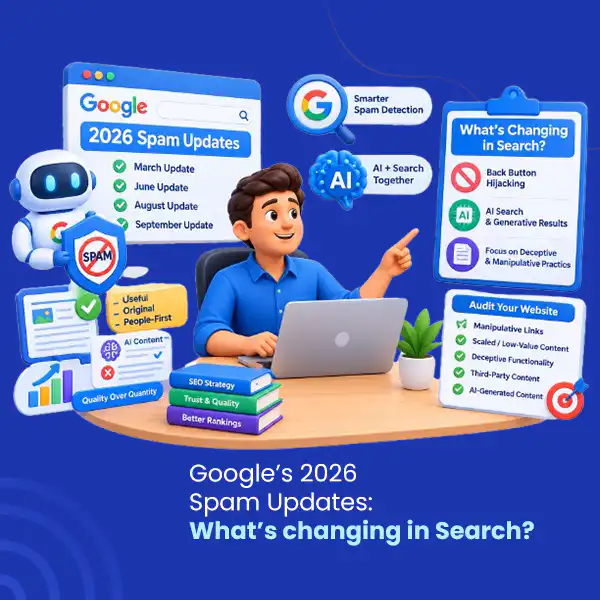
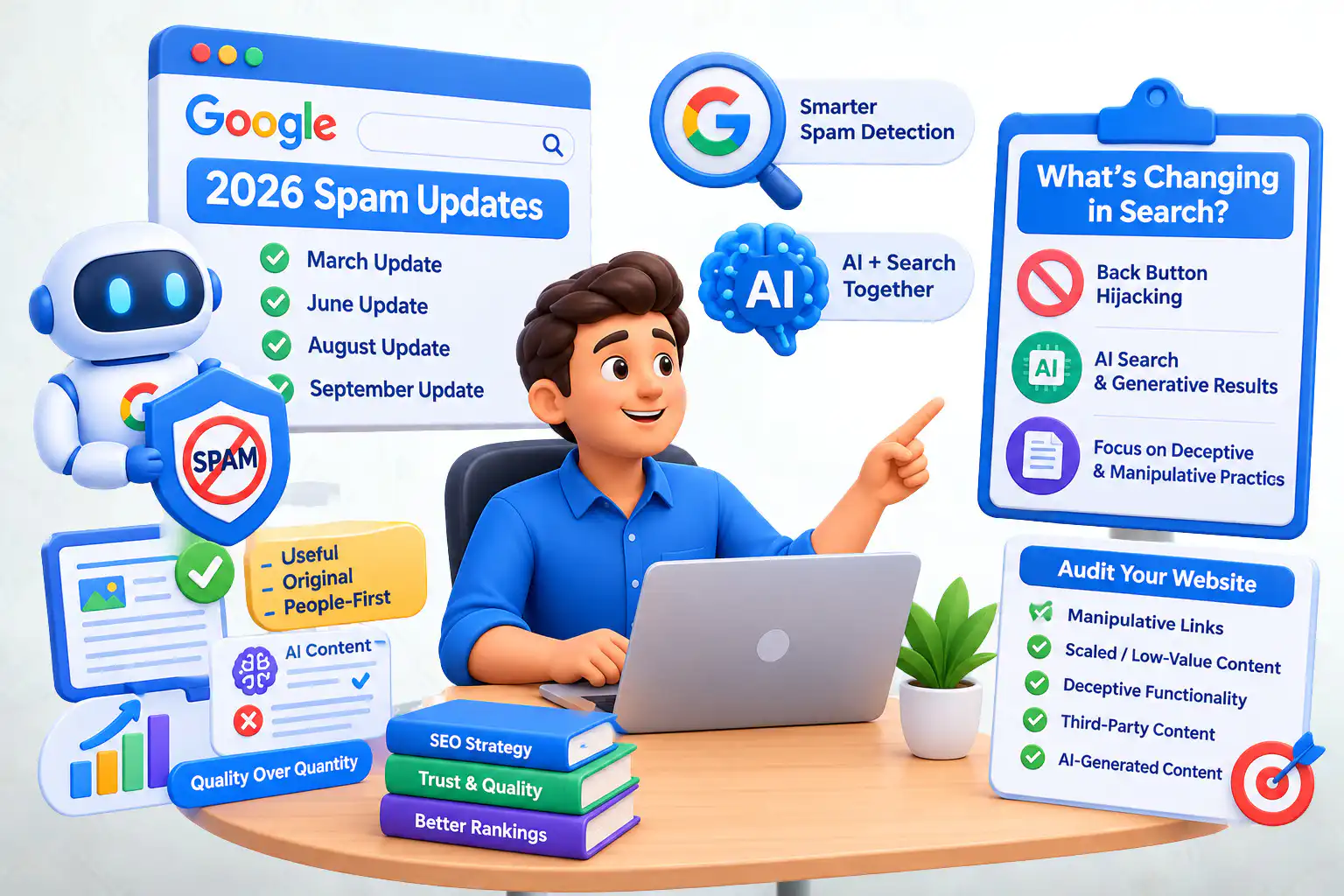
Google’s Search Status Dashboard records several spam updates during 2026, including updates in March, June, August and September. The September 2026 spam update began on September 24 and applies globally across all languages, with a rollout that may take up to two weeks.
What’s changing in Google Search?
One major shift is that Google spam policies are becoming increasingly focused on deceptive and manipulative experiences, rather than simply looking for obvious keyword or link manipulation.
For example, Google introduced an explicit policy against back button hijacking in 2026. This refers to websites interfering with browser navigation so users cannot naturally return to the previous page. Google stated that such behaviour could lead to manual spam actions or automated ranking demotions.
Another important development is the application of spam policies to AI-generated search experiences. Google clarified that its spam policies also apply to generative AI responses in Search.
This means businesses should not treat AI SEO as a loophole around traditional Search guidelines.
AI Content and Search Spam
AI has transformed how quickly content can be produced. However, producing large volumes of pages without adding genuine value can create problems.
The key consideration is not simply whether content was created using AI. Instead, websites should focus on whether the content is useful, original, and relevant and created for people.
A strong SEO content strategy should therefore prioritise:
- Original insights and practical information
- Clear search intent
- Helpful, people-first content
- Accurate and trustworthy information
- Natural keyword usage
- Strong website experience
- Transparent and non-deceptive functionality
In an AI-powered search environment, simply publishing more pages is not necessarily a sustainable strategy.
What Should Businesses Do After a Spam Update?
A ranking fluctuation after a Google spam update does not automatically mean that a website has violated a spam policy. Google recommends reviewing its spam policies when a site experiences changes following a spam update.
Businesses should audit their websites for:
- Manipulative links: Review unnatural or spammy link-building practices.
- Scaled or low-value content: Check whether large volumes of similar pages provide genuine value.
- Deceptive functionality: Review redirects, pop-ups, scripts and browser behaviour.
- Third-party content: Evaluate whether externally created content is being used primarily to manipulate search visibility.
- AI-generated content: Check whether AI-assisted pages offer original value rather than simply reproducing existing information.
The goal should be to build a website that remains useful even as Google’s algorithms become more advanced.
Frequently Asked Questions
They are improvements to Google’s systems for detecting and addressing search spam.
Google’s Search Status Dashboard lists spam updates in March, June, August and September 2026.
AI use itself is not the deciding factor. Content that violates Google’s spam policies can be problematic, including content created to manipulate Search or AI responses.
It is a deceptive practice that interferes with a user’s browser back-button navigation. Google made it an explicit spam-policy violation in 2026.
Review Google’s spam policies, inspect your website for potential violations and monitor performance through Search Console.
Staying Ahead of Google’s 2026 Spam Updates
The direction of Google Search updates in 2026 points toward a more quality-focused search ecosystem. Spam detection is becoming more automated, AI search is becoming more prominent, and deceptive user experiences are receiving greater attention.
For businesses, this makes sustainable SEO services less about chasing individual algorithm updates and more about building strong technical foundations, useful content, trustworthy signals and a consistent user experience.
At #1 Vinayak InfoSoft, we help businesses adapt their SEO strategy to changing search behaviour, algorithm updates and AI-driven discovery. If your website has experienced ranking changes or you want to strengthen its search visibility, connect with Vinayak InfoSoft to review your current SEO approach and build a search-ready strategy.