
Search is changing at a fast pace. Users are using Google search results, AI Overviews, ChatGPT, Perplexity and countless other AI-powered search engines to answer their search queries. What does that imply for enterprises? Generating more content is no longer enough, it needs to be planned on search intent, business goals, topical relevance, and AI-generated information discovery.
Here's where an AI-ready SEO content roadmap can help.
Start with the objectives of Business, not keywords:
A strong SEO Content Strategy should always begin with a very simple question, i.e. what is the ultimate goal of the content to achieve?
While traffic/rankings are significant, they should be tied to a business objective; for instance, they can be used to increase inquiries, help a service, grow brand awareness, or drive highly qualified traffic.
After you’ve settled on your goal, you should think about keywords that apply to the company rather than ones with a high number of searches.
Identify a Relevant Keyword Universe:
After that, the initial thing you need to do is to identify the topics through keyword research, competition research, website research, and content gaps.
Think beyond the words that you’re trying to find. Group and categorise topics of interest, and order questions customers are asking as they navigate your site.
One of its main services might involve informational searches, comparison searches, problem-based searches and high-intent service searches, for example. When viewed as individual pieces of content, it can result in disjointed content. A structured keyword clustering approach is helpful to build more powerful topical relationships.
Understand how to master the SERP and AI Search Results.
However, it’s not only keywords that you should consider in terms of search volume and the difficulty of those keywords. With the actual search results, you can see what Google believes in regard to the search query.
Look for AI Overview, People Also Ask, featured snippets, videos, or local results (or any other SERP features) with the keyword.
The purpose of AI search is not just about the rankings. Well-organised, informative and sourced content raises the chances of being quoted and referenced in the answers generated by artificial intelligence.
Focus on and make use of topics that relate to Intent & Opportunity
Don’t make a long list of keywords. It’s not a content strategy.
Instead, you should define a list of topics that are based on the search intent, commercial value, difficulty, authority, gaps in the content and AI-powered search visibility.
A low-volume, high-commercial-intent keyword would be better, as opposed to a high-volume, low-conversion-rate one, if a business wanted to target a keyword that had a greater chance of converting into a sale.
By doing this, you can ensure that your SEO content strategy is more focused and won’t waste your time on non-relevant topics.
How to transform a cluster into a content brief.
Once you have prioritised your topics, make these into content briefs that are practical. Each brief can include the following keywords: search intent, target audience, suggested content direction, internal linking potential, SERP features, and the page to target the topic.
It should provide an answer to the main question, contain well-formulated headings, include entities that are relevant to this question, include enough supporting information to show some understanding of the topic, and be sufficiently detailed.
AI can streamline the research and drafting process, but editors play a crucial role. The rule that AI-generated content can’t rank in search results is not universal. It’s the quality and usefulness of the final page that’s important. While it’s important to keep your website updated with accurate information and relevant examples, it’s even more crucial to produce unique, helpful content that offers a fresh perspective on the topic or some form of brand expertise. The process could be aided by AI, and human review can be used to verify the content aligns with the brand, search intent and adds value for the reader.
Be flexible with the Roadmap.
An AI-enabled SEO roadmap is not a 6-month program. Search behaviour and ranks can change, as can competition and AI search and business priorities.
Ongoing performance monitoring and roadmap changes based on ranking changes, organic traffic, conversions, content gaps and new search behaviour. One assessment for one content cluster can also be used to determine the effectiveness of the content cluster, prior to full conversion of the content process.
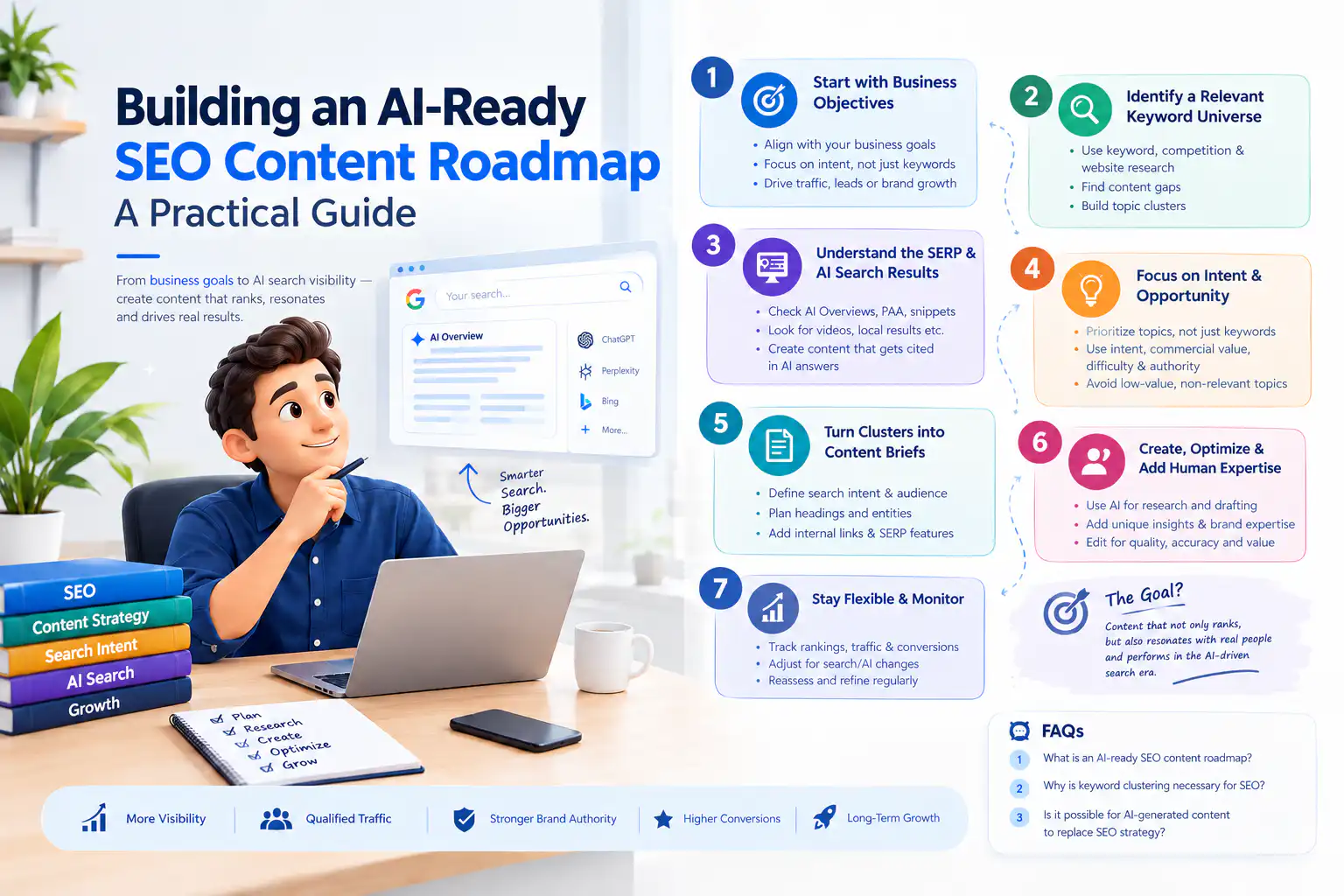
Frequently Asked Questions
It refers to a content guide that is SEO-centric, around Search intent, topical relevance and visibility within AI driven search experiences
Keyword clustering ties together related searches and enables businesses to centre their content on a more general search term rather than a specific keyword
Absolutely not, because AI cannot be fully used to write content or conduct research, but apart from that, it can help in both areas with fruitful strategy, expertise, accuracy, intent and editorial judgment
Conclusion
A successful SEO content roadmap bridges the gap between business goals, keyword research, search intent, topical authority, and AI search visibility. The ultimate goal is to create content that not only resonates with real people, but that will also be effective in the ever-changing search environment.
We #1 Vinayak InfoSoft we help businesses to craft effective SEO strategies that seamlessly integrate SEO fundamentals with the evolving needs of AI-driven search. If you need to discuss this, get in touch with us to talk about your content roadmap for the next phase of search.