
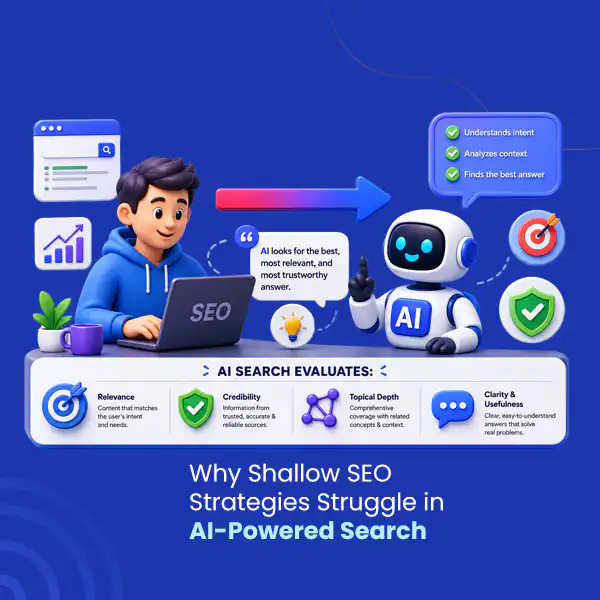
Searching is evolving at an accelerated pace. Users are not just limited to using conventional search results to get their questions answered. Instead, they are querying ChatGPT, Google AI Overviews, Gemini, Perplexity and many other platforms that are powered by artificial intelligence for direct responses.
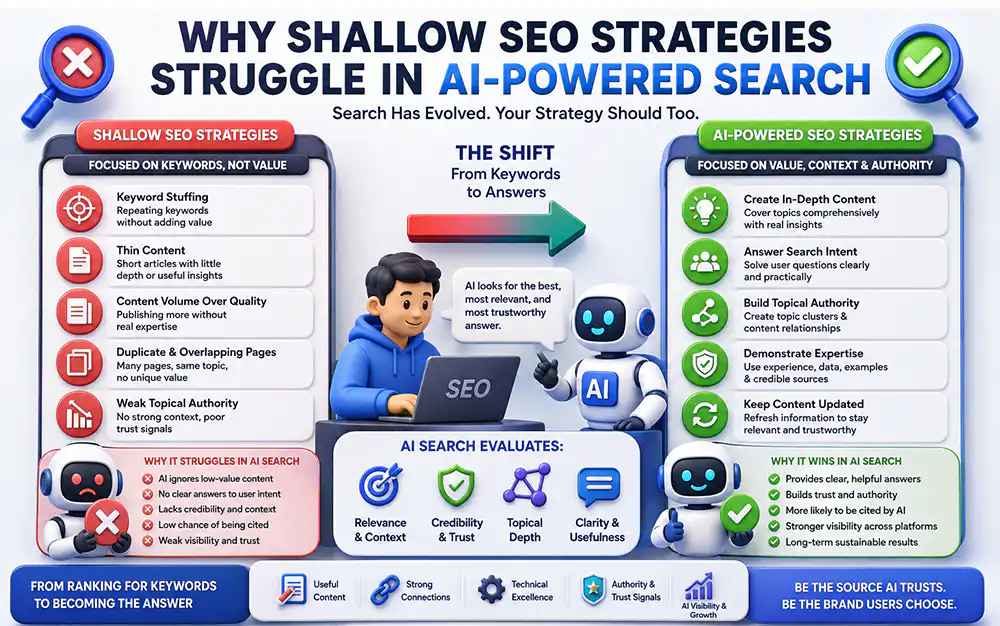
While a strategy that involved repeating keywords, creating thin articles and publishing as much content as possible would have been successful in the past, the way AI-powered searches function involves a lot more than that. AI-powered searches consider factors such as relevance, context, credibility and topicality of information to provide users with satisfactory answers.
What Makes an SEO Strategy “Shallow”?
Shallow SEO techniques usually consider superficial optimisation without value. These strategies include developing several pages with similar SEO keywords, rephrasing the same information without any additional ideas, or even writing some blogs that provide information that can be found on more than fifty competing sites.
Such content can sometimes generate impressions, but it has limited potential to establish topical authority. More importantly, AI systems have little reason to select or cite content that does not offer something useful, specific or trustworthy.
Modern search is increasingly moving from “Which page ranks for this keyword?” to “Which source provides the clearest and most reliable answer?”
Why Keyword-Focused SEO Alone Is Not Enough
Keywords remain important. They help search engines understand the subject of a page and connect content with relevant queries. But keyword optimization is no longer the complete strategy.
AI-powered search can understand variations in language, search intent and relationships between concepts. A page repeatedly using the same keyword without properly addressing the user’s underlying need can therefore struggle to stand out.
For example, a page targeting AI SEO services should not simply repeat the phrase throughout the content. It should explain what AI SEO means, how AI search retrieves information, how businesses can improve AI visibility, what factors influence citations and how traditional SEO connects with newer optimisation approaches.
That depth creates useful context around the primary topic.
AI Search Rewards Depth, Context and Clarity
Another point that distinguishes classic search engines from their AI counterparts is the method by which information can be extracted and repurposed. While the classic engine will show you the entire webpage, the AI engine might extract just one specific passage from it.
This makes content depth increasingly important.
A strong page should answer the main question clearly while also covering related questions, practical the effective page needs to address the core question clearly along with addressing some other questions as well as practical issues, examples, problems, and terminology associated with the topic.
This is the point at which SEO becomes semantic. It doesn’t have to just target exact match keywords but also create a topic, an entity, related ideas, and user intent.
Thin Content Can Weaken Topical Authority
Publishing more content does not automatically create more authority. In fact, excessive publishing of similar or low-value pages can dilute a website’s topical signals. Recent SEO research highlights how AI-driven retrieval systems increasingly value semantic clarity and consolidated authority rather than content volume alone.
Consider a website with ten articles covering almost the same topic. Each article offers slightly different wording but little additional value. Instead of strengthening the site’s expertise, the content can create unnecessary overlap.
A better SEO content strategy focuses on building a connected knowledge base where every page has a clear purpose and contributes something valuable to the overall topic.
Build Content That AI Can Trust
The future of AI search optimization is not about writing for machines at the expense of people. It is about making genuinely useful information easier for both users and search systems to understand.
Businesses should focus on:
- Creating original, experience-based insights
- Answering specific search intent clearly
- Developing comprehensive topic clusters
- Strengthening internal linking and content relationships
- Using structured and easy-to-understand content
- Supporting important claims with credible information
- Demonstrating expertise and authority
- Regularly updating outdated content
Research into generative search also indicates that earned media and authoritative third-party sources can play an important role in how AI systems perceive brand authority.
Frequently Asked Questions
Shallow SEO focuses mainly on keywords, basic optimisation and content volume without providing sufficient depth, originality or value to the audience.
AI systems increasingly retrieve and evaluate information based on relevance, context, clarity and authority. Generic content can therefore struggle to become a preferred source or citation.
Yes. Technical SEO, crawlability, quality content, internal linking and authority remain important foundations. However, businesses also need to consider AI search visibility and content designed for retrieval and citation.
Businesses should develop comprehensive content, demonstrate expertise, strengthen topical authority, answer user questions directly and build credible brand mentions across relevant sources.
Topical authority demonstrates that a website has meaningful and connected expertise around a subject. Strong topical coverage can help search systems better understand a brand’s relevance and expertise.
From Ranking for Keywords to Becoming the Answer
The goal of modern SEO strategy should not simply be to rank for more keywords. It should be to become a reliable source that search engines and AI systems can understand, retrieve and confidently reference.
That requires moving beyond shallow optimisation and investing in topical authority, helpful content, technical SEO and AI visibility as interconnected parts of one strategy.
At #1 Vinayak InfoSoft, we help organisations change their search approach based on how search is changing with the rise of AI. Get in touch with us today to create an SEO plan that can work in both worlds of search.